“In Kenya, I learned the theory. At //kood, I learned to actually build software.”
Three Kenyan engineers · Tallinn · Digital Explorers
By the //kood team · May 2026
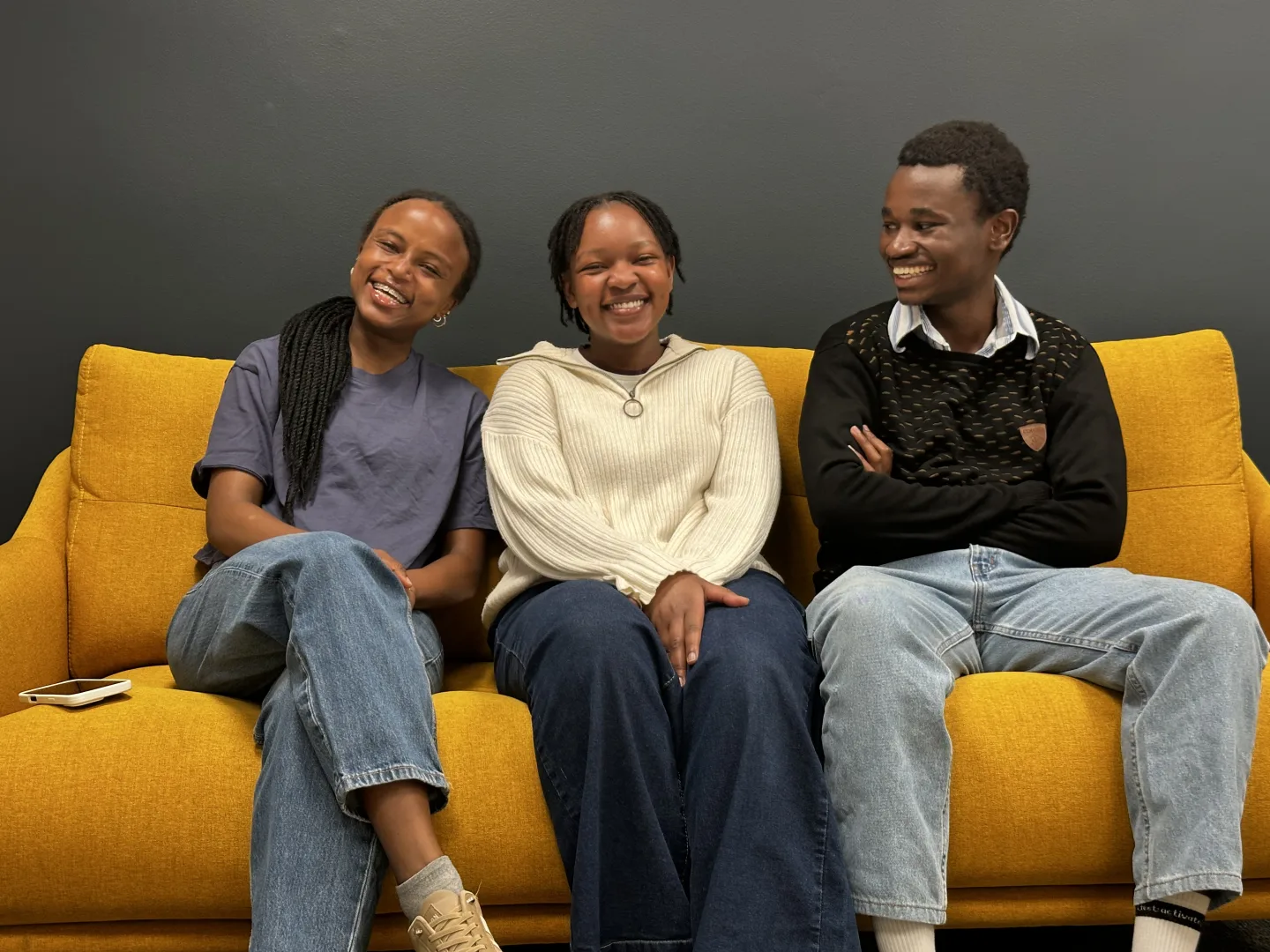
Three Kenyan software engineers and recent university graduates spent the cold spring with us in Tallinn as part of the Digital Explorers programme. They didn’t just learn at //kood, they also built something that will soon shape how our students learn every day. This is their story, in their words.
When Jamie, Grace and Gilbert walked into the //kood offices in Tallinn back in February, they didn’t know much about us and they definitely didn’t know what they had signed up for. All three had started their journey in Nairobi where access to real-world engineering experience during studies is still the exception, not the norm.
They had earned their spot at a Digital Explorers hackathon the previous November, a 48 hour hackathon where they were given a problem to solve: how to enhance trust and quality of peer-reviews?
They built a prototype on the spot. They placed in the top five. And a few months later, they were in Estonia, sitting in our office, being asked to turn that idea into something real. What followed were two parallel tracks of work.
The visible one was the product: a prototype of an AI enhanced peer-review system for //kood students, where AI steps in to measure review quality step in at the right place to offer guidance & support.
The less visible one, the one Jamie, Grace and Gilbert keep coming back to, is what changed how they see themselves as engineers. “From day one, they worked like full members of the team, not interns. They asked the right questions, challenged assumptions and built something we’re genuinely excited to put in front of our students,” Kaur Järvpõld, //kood CPO and mentor to Digital Explorers commented.
Learning to slow down
In Kenya, Grace told us, software development often looks like this: “Business asks for a product, and they want it in a month or two. They don’t want you to waste time collecting data. They want you to jump to the solution.”
At //kood, Kaur asked them to do the opposite. For a full month, the three interns ran user interviews, sat in on student reviews, spoke with engineers and built nothing. “I was complaining. I told my lecturer back home that we were wasting time. But now, looking back, we haven’t had to go back and fix something we built wrong. That culture was completely new to me,” said Grace.
That shift from “ship and learn” to “learn, then ship” was, for all three of them, the most professionally formative moment of the internship. Not a technical skill but a way of thinking.
Learning to be trusted
The second shift was about how work itself is organised.
Gilbert came to Tallinn from a tech culture where seniority is visible - corner offices, hierarchy, presence often measured in hours at a desk. At //kood, he found something very different. “You can literally share a desk with your CEO. You feel like you’re all working towards the same thing. There’s no micromanagement but that also means the responsibility is yours,” Gilbert said.
For Jamie, the shift came through the work itself. After years of computer science theory at Strathmore and an internship that didn’t quite click, she finally got to build something end-to-end: backend, frontend, interaction design, storytelling. “It was just perfect. To apply what I was learning in school. There’s been so much learning,” said Jamie.
Learning what the work is for
There is a particular kind of confidence you don’t get from a classroom, the confidence of building something real, for real users. Jamie, Grace and Gilbert leave with that. A working prototype that will soon be used by hundreds of learners, not as an exercise, but as part of a real product.
But they also leave with something else: a clearer view of the gap between how they were trained and how they could work. “In public universities in Kenya, most of what we’re taught is not applicable in the job market. It’s a lot of theory. The degree didn’t fully meet my expectations. But I kept building on my own, hackathons, side projects, and communities. That’s where the real growth happened,” Gilbert commented.
That self-built layer - the hackathons, the side projects, the peer learning is exactly what //kood is designed to make part of the system itself. So the next generation doesn’t have to build it alone.
What happens next
kood/Nairobi piloted last year in Kenya, this year we’ll open our doors in partnership with Kenyatta University and supported by ESTDEV. Twelve students are already studying in Nairobi. Applications for the next cohort are opening soon. Check out koodkenya.tech
Gilbert summed it up best: “Kenyans are the most ambitious people out there. We have massive talent. If you show people what an opportunity actually looks like, what others have built, where it leads, they will go all the way. If //kood had found us in school, we’d have been first in line.”
Digital Explorers is a talent partnership programme co-funded by the European Union and run with partners across Estonia and Kenya. kood/Nairobi is launched in partnership with Kenyatta University. Both projects are supported by EstDev.
20 July – 07 August 2026 · Kenyatta University